

MCP tools
Contents
- Fill missing inputs with your agent
- Open a graph
- Available tools
- Protocol and implementation
- Canvas views
- Runtime input contract
- Retained execution inspection
- Source proposals
- Captured source proposals
Arguments and results for the extension endpoint and the shared host tools. Connect a client in Connect MCP. Transport limits and the browser link are in MCP security.
read_model_source and propose_source_set are registered only for the canvas agent (registerCanvasCodeTools in extension/src/mcpProposals.ts). They are not in the table below. The plugin panel transport tools are listed in the reference.
Fill missing inputs with your agent
The call sequence is in Connect MCP. Each binding is { args: [...], kwargs: { name: value } }. A value is a JSON scalar, a { "kind": "float"|"none"|"list"|"tuple"|"dict" } tag, or a tensor description:
{"kind":"tensor","shape":[1,3,224,224],"dtype":"float32","requires_grad":false,
 "generator":{"kind":"normal","mean":0,"std":1,"seed":0}}
Generators are normal (mean, std, seed; floating only), uniform (low, high, seed; floating only), randint (low, high, seed; integer only, low < high), full (value) and values (exactly product(shape) literals; a bool tensor accepts only booleans). Dtypes are bool, the integers uint8/int8/int16/int32/int64, and float16/bfloat16/float32/float64. Shapes have at most 32 dimensions and 4,194,304 elements. inputContract states each rule explicitly; these bounds are not a substitute for reading the model's own forward.
Open a graph
open_graph is available before a model is open. Pass an absolute Python file and cls, or omit them to use the active editor. A file with several model classes returns their names.
The tool opens Canvas and uses the same setup and capture flow as Open as Graph. Saved profiles are reused. Poll the returned requestId; polling does not start another capture. When inputs are missing, submit draft with requestId, openingId, and sourceDigest to save tensorviz.toml and continue.
continuationRequired and nextAction mean the opening is not finished. Keep going in the same task while that flag is true. A source-only preview is not a completed capture. nextAction names the tool, arguments, and any values you still have to supply. action: select_environment uses a listed candidateId. action: refresh_environments only refreshes the list. action: install_dependencies uses the returned requirements; the editor still asks before it installs. action: cancel stops this connection's opening. action: retry resolves setup again. After an error, change the setup or environment before retrying the same arguments.
If you cannot proceed, call open_graph with action: report_blocker, the current request identity, and blocker: { reason, evidence, nextStep }. A blocked request returns status: blocked and continuationRequired: false. Only a successful capture returns validated: true.
One endpoint can see every local tensorViz window. open_graph routes an absolute file to the window that owns it. Ambiguous matches return HOST_REQUIRED; pass hostId to choose a window. Requests belong to the MCP connection that started them. Disconnect cancels that connection's pending work.
get_execution_environment reads the interpreter tensorViz will use for capture. It does not install packages or open a picker. Install missing libraries into that interpreter. Do not switch to the agent's shell Python because an import failed. Agent-supplied URLs, local paths, and pip directives are refused. The user approves the exact package versions before installation. Declining, a source change, or a disconnect stops the next step. A failed install never reports a validated graph.
A source change during opening returns status: source_changed. Save, then start a fresh request for the same file and class. That is different from cancelled, which stops.
Available tools
| Tool | Input and result |
|---|---|
open_graph | Start opening a file/class, poll progress, submit missing inputs, retry or cancel through one session-owned request. See open a graph. |
open_graph_diff | Open Git HEAD versus current Python files in Canvas and the native code diff, including staged and unsaved edits. Optional absolute file, cls and hostId; returns the selected model, changed files and source coverage notes without execution. |
get_execution_environment | Read TensorViz's resolved interpreter, selection source, prefix, Python/Torch/pip versions and platform without opening a graph or an environment picker. |
get_graph_setup | Opening progress and source-only discovery of constructor/input fields, examples, configuration types, factories and enclosing models. Available before a graph exists. |
suggest_graph_inputs | Pending setup packaged for an LLM: model file/class, constructor and input fields with annotations/defaults, examples, constraints, unresolved values, the exact draft skeleton to fill, and inputContract (the tensor/generator/dtype grammar). Source-only. |
configure_graph_setup | Current opening id/source digest and an explicit draft; saves setup and continues one forward capture. Poll get_graph_setup for progress or missing fields. |
list_models | Every live graph in every tensorViz window, each model id, revision, owning host, source identity and freshness; canvas view ids are tagged with their host. |
get_graph | Model id/revision; summary or paginated nodes/edges. Optional node ids select an internal subgraph. |
list_captures | Model id; latest attempt and retained complete/partial/displayed capture identities, including manual/browser runs. |
inspect_capture | Model id, capture/source ids and a paginated path; exact operations, calls, argument trees, values, state, effects, coverage and diagnostics. |
get_model_context | Current model id/revision; compact recorded module calls, aliases, registered parameter counts and tensor shapes. Defaults to 4,000 UTF-8 bytes; exact focus and maxBytes retrieve omitted modules. See model context. |
get_selection | Model id/revision and a view id from discovery; selected nodes and real connections. |
focus_view | Model id/revision, view id and nodes or one edge; expands ancestors and waits for a canvas receipt. |
validate_model | Model id/revision and positional tensors or explicit execution setup (fixtures, keyword inputs, constructor/factory/checkpoint, device/mode); returns a run id. One forward capture. |
get_run | Run id; progress, originating source/input context, outcome and resulting projection reference. |
inspect_run | Run id; immutable graph, failing operation and input shapes, contributing operations, module coverage, source and execution setup. Paginated; works after the live graph changes. |
compare_runs | Two completed execution run UUIDs, not capture ids; returns comparison data, without opening a visual Git diff. Canonical arguments/effects/sharing and exact operand uses, with separate observations, setup and numerical outputs. Explicit uncertain correspondence; paginated, no execution. |
propose_edit | Model id/revision and one typed source edit; captured nodes require a listed edit capability. Returns a proposal id for native review. |
get_proposal | Proposal id; preparation/review/outcome and native diff metadata. |
run_proposal_candidate | Proposal id and retry UUID; explicitly runs the exact copied review with its retained setup. |
cancel_proposal_candidate | Proposal/run ids; cancels only that candidate and waits asynchronously for cleanup. |
list_proposal_candidates | Proposal id; private retained native/MCP candidate summaries. |
inspect_proposal_candidate | Proposal/run ids and optional capture query; summary or exact paginated canonical evidence. |
inspect_applied_proposal | Proposal id; read confirmed Apply, current source/save state and later capture effects without execution. |
cancel_run | Run id; cancels only the calling session’s validation. |
inspect_nodes | Model id/revision and node ids; parameters, source references, shape provenance and paginated connected edges. |
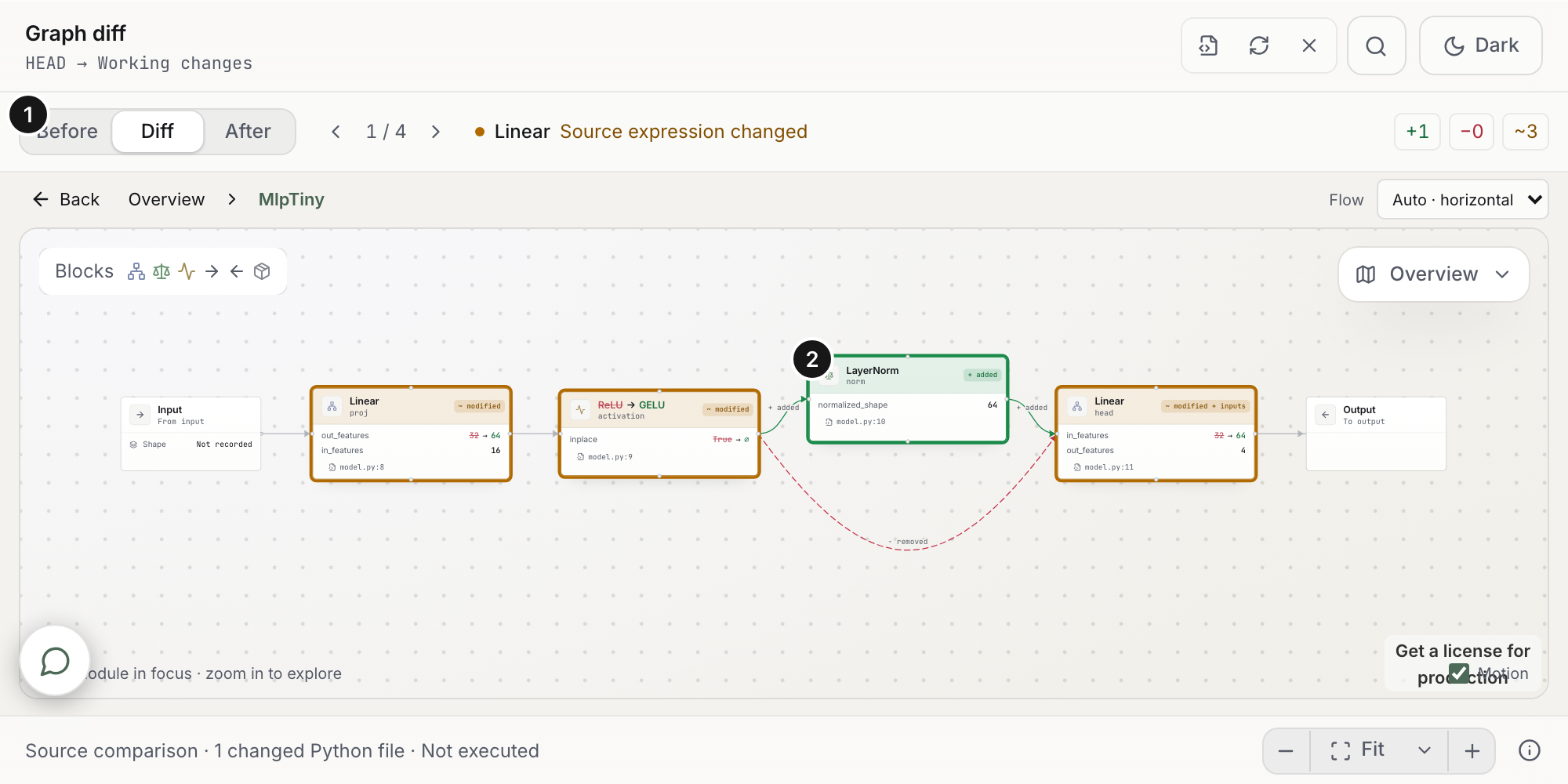
Show local changes in the graph
Ask: “Show my local changes in the TensorViz graph.” The agent should call open_graph_diff, without recapturing the model first. It uses the retained Canvas model or active Python editor; file and cls select a specific model. hostId selects the VS Code window when routing is ambiguous. A local Git commit is needed; the code does not need to be pushed to GitHub.
The tool opens the existing comparison and preserves a matching captured graph as context. Results contain status: opened, the selected and available models, changed files and source coverage notes. It returns after preparing and opening the comparison, without waiting for Canvas rendering confirmation or reporting displayed change counts. Green marks additions, red removals and amber modifications. Unmapped edits remain in the change navigator; zero mapped highlights do not prove that the source is unchanged. Retained shapes describe the earlier capture.
This action reads source without saving, applying proposals or running the model. For an edit that has not been made, use propose_edit first: the user reviews the native code diff and chooses Apply or Discard. After Apply, open_graph_diff can show the accepted source change. Accept/Apply saves only reviewed files and opens the model with its current saved setup. compare_runs compares existing execution records and cannot open this Git review.
Inspection never executes Python. The endpoint rejects stale revisions, missing node ids and ids from an unavailable host; tools for a model owned by another window are routed to that window. Refresh discovery after editing the source. Unknown shapes stay unknown; observed shapes read the worker’s recorded tensor dimensions. Declared shapes retain declared provenance and unreached nodes have no measured output. Canonical source coverage also preserves not_observed, capture_limited, static_only, unresolved, failed and state; missing evidence never becomes a cached output shape. State shapes describe parameter/buffer values, not calls. The backend document publishes module ownership in semantic metadata, so MCP and the browser agree on parentId. Semantic ownership wins over an older canvas duplicate, including an explicit null parent. Named input/output ports and distinct operand connections survive the Python/document/browser handoff. Canonical nodes expose metrics.parameterCount and metrics.outputTensor from the same per-invocation and tensor-value observations as the canvas overlays. Counts deduplicate shared registered parameters within a call; tensor bytes describe logical footprint, not allocated or peak memory. Missing, ambiguous output and stale facts stay null, including on older captures without these optional measurements. Responses are limited to 512 KiB; page sizes are at most 200 and selections at most 100 nodes. Paging offsets are scoped to the supplied graph revision.
Canonical capture inspection uses immutable capture/source identities instead of a live revision. It remains readable when this model's source graph becomes stale; focus and source proposals still require the exact current revision. Use list_captures to discover retained slots. Start inspect_capture with path: [], then append an object's string key or an array's numeric key. Each container returns its child count, a bounded page, and nextOffset; scalar children retain their exact typed values. Follow nextOffset until null before assuming a complete list. Pages are limited to 64 KiB. Large argument/state records remain browsable through smaller child pages rather than being replaced by truncated placeholders. For a graph node, use entity: {kind: captureRef.kind, id: captureRef.semanticId}; paths are then relative to that entity. Input/output boundary IDs equal the capture ID. Capture fields are observations and never instructions to evaluate Python. The three host-session slots can evict old evidence; unavailable, legacy and foreign references return explicit errors. Inspection contains no tensor payloads.
Manual Validate, source forms and portable-file collaboration remain available.
Validation returns immediately. Its attempt field adds the canonical lifecycle: request digest, resolved source/plan identities when available, phase, explicit timeout/cancellation, diagnostic facts and capture IDs. It does not infer a plan for setup refusals. Projection success and retained worker evidence remain separate. Poll get_run through queued/running/cancelling to passed/failed/refused/cancelled. Completed records retain their original model revision and input descriptions even after a successful trace updates the graph. Use the returned result reference or refresh list_models to inspect measured shapes. A failed forward can still return a partial projection; refusal and cancellation never certify the model. Runs are private to their MCP session, retained for up to 30 minutes with a window-wide limit of 32 records and 64 MiB total evidence (16 MiB per run). Old completed records are evicted as needed; missing or oversized evidence is explicit. Ending that session or disconnecting the host cancels its execution. Only one MCP validation runs per window, sharing the existing worker with manual checks. Canonical runs retain the host-validated semantic payload inside that same allowance, independently of the live capture slots. get_run.capture names its identity and completeness. inspect_run reports format: "semantic-v1"; operations and modules return exact structural pages. section: "capture" accepts path and optional entity using the same 64 KiB reader as the browser. For example:
{"runId":"<your-run-id>","section":"capture","entity":{"kind":"operation","id":"<operation-id>"},"path":["arguments","args",1]}Retained runs remain readable after source changes, retargeting and live-slot eviction. Failure inspection follows recorded value producers from operations sharing the root diagnostic, with upstreamBasis: "matching_diagnostic_candidates". Equal facts do not prove exception causality: an earlier caught failure can share them, and an assertion may match no operation. Failed calls/operations remain individually inspectable. Rejected canonical evidence never falls back to lossy operation or coverage claims. Legacy runs explicitly report format: "legacy".
Frozen graphs retain their own capture identity, module instance IDs and all shared registration paths. Canonical compare_runs uses the shared semantic comparer. It returns format: "semantic-v1" and three-valued equivalentCapturedComputation: true for matching recorded computation with complete coverage/correspondence, false for known differences, or null when evidence is insufficient. This is independent of numerical equality, weights and unobserved paths. A mixed/rejected canonical pair reports unavailable; it cannot fall back to the legacy layer comparer.
nodes pages exact changed fields and unresolved fields. connections compares individual argument/effect/result uses, including two separate operands in a + a. correspondence pages established pairs, unmatched records and uncertain groups. Numeric container indices and indistinguishable repeated operations remain unresolved. Graph node/edge IDs are supplied only when retained capture references resolve uniquely. observations/coverage stay distinct from computation changes.
Each collection page stays below 60 KiB; inline values are bounded to 4 KiB and larger fields provide an explicit size descriptor plus baselineInspect and candidateInspect requests for the exact inspect_run tree. These display bounds do not affect comparison. There is no canonical first-intermediate-value divergence claim: canonical metadata alone cannot establish it. Legacy comparison is labelled format: "legacy" and retains its older fingerprint behavior.
Save model/dependency buffers first and grant VS Code Workspace Trust. Execution uses the chosen environment and existing Torch/CUDA versions. open_graph can request model dependencies, but installation requires native VS Code approval of a frozen additive plan. It never replaces existing packages. The worker has the same 180-second process limit as manual Validate; the complete validation operation is cancelled after 210 seconds. When a package has no compatible wheel, source builds need approval before package build code runs, followed by review of the resulting installation plan. Dependency repair stays in TensorViz's reported capture environment.
Environment recovery in Canvas and MCP shares the retained model opening. select_environment accepts a listed candidate ID; refresh_environments checks metadata only. Known missing libraries return their exact reviewed-install action. An unexpected failure supplies a copyable direct MCP investigation request and the originating attempt context. See open a graph and environment recovery.
All connected views receive progress and the measured projection. Completion reuses Validate’s node sweep: observed nodes glow green, mapped failures red, and unreached nodes stay unverified. Cancellation/refusal or an outdated source cannot replay a pass.
Protocol and implementation
The endpoint implements standard initialization, tools/list, tools/call and session termination using the official MCP SDK. Requests use JSON, with a 64 KiB body limit. Host and Origin checks apply to every HTTP method. The server allows up to 16 sessions per window and expires sessions after 30 minutes without a request. Clients should initialize again after an expired-session response.
VS Code owns source buffers, workspace/model/view identity, review, Undo and execution. Python services parse, transform and trace. The browser owns presentation. Source changes must remain Python proposals for native Apply/Discard review.
Packaging bundles the SDK into out/extension.js via extension/scripts/bundle-extension.mjs; no node_modules tree or separate runtime is installed by the user. Agent setup parsers are bundled too; the JSONC parser uses its ESM entry so its internal modules are included in the VSIX. Their license notices ship in extension/MCP_PARSER_NOTICES.md.
Canvas views
list_models includes broker-assigned view ids and whether each selection matches the current source. Each browser connection has its own id; reconnecting replaces it. Pick the intended view explicitly when several pages are open. get_selection refuses stale, oversized or unavailable selections. Display-only collapsed edges are not semantic connections; expand their block before selecting an edge.
focus_view accepts either up to 100 node ids or one semantic edge id. It expands ancestor blocks, selects the requested content and fits it at a readable zoom. The result is successful only after that exact page confirms focus against the same source revision. A closed, stale or unresponsive page yields an explicit error. This changes presentation only; it never changes the Python model.
Runtime input contract
The trace worker accepts structured positional tensors (shape, dtype, fill). Shapes have at most eight positive dimensions; requests contain one to eight tensors and at most 4,194,304 elements total. Supported dtypes are float32, float64, float16, bfloat16, int64, int32 and bool. Fills are zeros, ones and deterministic randn (floating point only). Legacy tensor descriptions start on CPU. Alternatively supply execution (and omit inputs) to use a workspace fixture, keyword tensors, constructor arguments/model factory, checkpoint, explicit device and train/eval/preserved mode. The fields are a tensorviz.toml profile. Explicit execution never falls back to another interpreter. Input bounds apply; the model itself can still allocate memory or execute arbitrary workspace code, so Workspace Trust and worker cancellation/timeouts remain required. Arbitrary expressions are outside the MCP input contract. Named workspace setup functions are explicit trusted-code execution.
Worker argument validation runs before Torch, Pydantic or the model is imported; the ingestion package defers its public exports until they are requested.
Retained execution inspection
inspect_run accepts runId, section, offset and limit (1–200). Sections are summary, graph, setup, capture, failure, operations and modules. The canonical capture section also accepts an optional entity and JSON-tree path. Each collection returns its own count and next offset. Graph pages name their snapshot revision; the run keeps its originating revision separately.
Legacy failure inspection returns all captured input tensor shapes, the failing operation's source and paginated upstream producers. Module coverage distinguishes entered, completed and unreached modules. A Python error outside a tensor operation has no invented failing operation; its workspace traceback remains available. Error types, cause types and missing module names are structured; arbitrary exception text, stdout and stderr are not forwarded to clients.
The legacy worker bounds operation evidence to 8192 operations, 4096 module calls and 64 tensors per operation. It retains the failure even if earlier evidence was truncated. A truncation flag and missing upstream count disclose incomplete paths. Setup pages include input/state identities and paginated tensor metadata. These measurements describe that one captured call.
Inspection runs no Python and does not require the current graph revision. Completed records are immutable. Cancelled/refused runs can retain useful captured facts but cannot certify the current model. Source, setup, fixture and checkpoint changes are checked before presenting a current validation result.
Source proposals
propose_edit accepts one set_param, add_layer, remove_layer or group_layers intent. Use semantic node ids from this graph revision. Parameter values are bounded literals; the tool accepts no source text, expression evaluation, arbitrary paths, automatic Apply flag or shell commands. Unsupported source constructs return a useful refusal; the agent can edit Python normally and let the live graph refresh.
Poll get_proposal for preparing, review, applied, cancelled or refused. During review, the result identifies the native diff’s file, title and before/after digests. Shared source definitions and grouping’s parameter/checkpoint key changes are disclosed in that title. The user chooses Apply source change or Discard proposal in VS Code. Apply is a single undoable WorkspaceEdit; native Undo restores it. The same freshness, Workspace Trust and dependency checks used by browser forms apply to MCP proposals.
For captured edits with a retained resolved setup, explicitly Run reviewed candidate in the native diff or call run_proposal_candidate. get_proposal includes a bounded review.candidate summary separating runtime outcome, freshness, capture coverage, actual input/state equivalence, cleanup and semantic postconditions. Literal, activation, reconnection and unary edits include bounded postconditions evidence tied to the candidate execution, capture and exact source binding. verified covers that observed expression only; failed means a captured operand or recognized activation differs, and unavailable gives a closed reason such as partial capture or an unsupported recipe. Other executions are unverified. Older or unexecuted summaries retain not_checked. The retained run keeps the same evidence after Apply/Discard, with source freshness and historical status separate. Activation counts include every observed call at the functional or constructor expression, including shared instances. Unused instances and other inputs remain unverified; incomplete write/alias evidence cannot certify an in-place replacement. Reconnection resolves the requested source variable separately in each candidate call and checks the selected argument use. A correct first occurrence cannot hide a later mismatch; original-run value IDs are not candidate correspondence. Insertion checks the exact activation call and its original input, and requires its output to feed the selected argument. An activation elsewhere is insufficient. Deletion checks the exact replacement name and the full surviving flow in each observed forward call. Its evidence binding points to that forward definition; absence of the old operation alone cannot verify the edit. Source Apply status stays separate: applying a static-valid edit cannot turn a failed candidate into a successful run. Reading a proposal never executes anything.
run_proposal_candidate({proposalId, requestId}) returns immediately with a candidate record and runId. Generate a UUID requestId for an intentional run and reuse it when retrying a lost response. Retries return the same run after review closes; an evicted result reports unavailability without reexecution. Requests made during a pending run share it. Up to 128 request IDs are remembered per proposal; reaching the bound refuses new requests while existing retries remain readable. Runs execute trusted Python in a copied workspace; Python can still access absolute paths and services. The tool advertises execution side effects and never applies source.
Poll inspect_proposal_candidate({proposalId, runId}) for runtime and cleanup status. cancel_proposal_candidate targets that exact run; an older run cannot cancel a newer one or discard the source proposal. list_proposal_candidates includes native Run actions too. Apply/Discard waits for cleanup through the same native lifecycle.
To inspect a capture, copy candidate.capture.captureId and sourceId into the optional query of inspect_proposal_candidate, starting at path: []. Use child paths and nextOffset as with inspect_capture. Canonical JSON is immutable; pages preserve exact argument order, repeated value uses, state and coverage. Private candidate records cannot be focused in the live graph. Capture-less construction failures still retain a runtime summary.
History is bounded to 32 runs, 16 MiB per capture, 32 MiB total and 30 minutes after completion (start for unfinished runs). Payload eviction/oversize/validation failures leave explicit reasons in the summary. Closed reviews are historical: freshness is the last review observation, not certification of the edited buffer or environment. Session ownership is checked before every control or read; another client's proposal or run IDs grant no access. Proposal eviction, session termination, revocation and host disposal forget associated evidence. Late worker completion cannot restore it.
After native Apply of a captured edit, inspect_applied_proposal({proposalId}) returns applied: the confirmed receipt, checkedAt, current source/save state, capture-setup freshness and recorded effect comparison. Unsaved reviewed bytes, saved reviewed bytes, restored original bytes and other edits are distinct. Only the latest finished post-Apply capture participates; a newer failed/no-capture run cannot borrow an older success. Observed effects, input/state identity and partial dependency scope remain independent. Without a retained resolved setup, current environment freshness is unavailable even when the recorded effect is verified.
This read neither saves nor runs the model; save and explicitly validate separately. It uses bounded private source evidence (24 MiB/receipt, 32 MiB total, 32 records, thirty-minute access lifetime) and fixed safe errors. Native source writes and historical candidate results remain unchanged. Ownership is checked again after reading; revocation, expiry and cancellation prevent a late result granting access. The ninety-second host deadline includes static setup checks. Results describe the instant checked, not continuing certification, and source restoration does not prove that native Undo occurred.
One native source review is allowed per window, shared with the browser. Discard or finish it before making another proposal. Disconnecting the owning MCP session or host cancels pending work. A proposal expires after 30 minutes. Completed results are private to the originating session and remain readable after source changes, with at most 32 records retained for up to 30 minutes. There is no MCP tool for automatic application.
The extension has no provider settings, API-key commands or built-in agent panel. External agents own their model access. Native source editing and traceback links remain independent of MCP. Git graph diff is a separate Canvas review, not an execution comparison.
The browser protocol accepts only typed source proposals and validation requests; old chat messages and free-form source-chat intents are rejected. Request results remain private to the originating browser view, with cancellation on disconnect.
Broker regression tests also cover concurrent source reviews and validation requests: a reply of the other kind cannot consume a pending request.
The Python backend does not load provider clients, agent frameworks, or chat endpoints. Its project and managed-runtime requirements omit those packages. Graph projection, deterministic source transforms and trace workers remain available. Packaging refuses AI runtime/router files and still excludes user environment files.
To verify a clean backend environment, install backend/requirements-project.txt in a separate venv, then run python backend/scripts/check_provider_free_runtime.py. It refuses environments containing provider frameworks, starts an authenticated local HTTP server, checks removed routes return 404, projects source that would raise if executed, prepares an edit without writing the file, and runs a separate real trace.
Recovered execution errors
Module calls distinguish completed and failed invocations, including exceptions caught by a parent before a successful fallback. Failed calls have no invented outputs. A recovered tensor exception remains in operations and lastObservedFailure with its disposition; it is not the run's terminal failure. An exception linked through the final Python exception chain is labelled as such; otherwise its relationship to a failed run is unknown. Eager call instrumentation is removed after both successful and failed tracing.
Source identity during execution
Save changed Python buffers before starting an explicit execution. The worker records the exact workspace source bytes compiled by standard Python imports, including helpers imported by setup, forward and loss functions. It compiles source directly instead of trusting cached bytecode. The host checks these file identities and unsaved buffers before presenting a current validation result, including after graph refresh. A changed helper leaves the immutable run available but refuses certification of the current source. Imports are bounded to 4096 source loads and 64 MiB; workspace bytecode-only imports are refused. Installed packages are environment dependencies. Custom loaders, dynamic exec and arbitrary data/configuration reads are outside this source-identity guarantee.
Output limits
Worker stdout is capped at 32 MiB and stderr at 1 MiB. Exceeding either stops the worker and produces OUTPUT_LIMIT, without claiming a model failure or parsing a partial result. Run setup inspection pages input/state entries, module modes, imported sources and checkpoint key differences separately. Follow each collection's nextOffset; a byte budget may shorten the requested page. A single record larger than 64 KiB is explicitly unavailable in legacy record paging. Canonical records use structural child pages, so large records remain traversable without truncation.
Canonical live graphs expose captureRef, captureLabel, capturedOperationCount and typedPorts in graph/node inspection. Each typed port keeps its ordered argument path, value identity, shape, dtype and device. Edges include captureEdge with the original value-use record; equal endpoints do not deduplicate distinct destination arguments. Graph summaries include capture/source identity, status, omissions and operation/invocation counts. Existing model/revision guards and result-size bounds still apply. Full argument/value/state paging is available through inspect_capture, inspect_run's capture section and the browser’s View captured details dialog, using the same host inspector.
Canonical graphs mark each recorded failed operation/call directly. Missing source calls remain not-observed, capture-limited or unresolved according to their actual coverage; a missing graph node never proves an untaken branch. Legacy graphs attach a mapped failure badge only where their retained module evidence is unambiguous.
Captured source proposals
inspect_nodes returns sourceEditCapabilities and sourceEditLimitation for captured nodes. An exact binary_scalar_v1 capability enables propose_edit with kind: "set_literal", its node id, capabilityId copied from the capability's id, and its exact target, argumentPath, expected and scope: "source_expression". Supply value as {kind: "int", value: "2"} or a finite tagged float. Integers are decimal strings to preserve precision; float negative zero uses value: "-0".
straight_line_tensor_v1 enables kind: "reconnect_argument". Copy the capability id, exact target, argumentPath, expected ValueRef and scope: "source_expression"; choose a value ValueRef from its choices. This selects one operand use even in a + a. Do not submit a variable name, source expression or layout-based producer selection. Available values are proven against source order across the captured shared calls; this does not establish shape compatibility. Native review checks that the patch changes only that operand to the chosen name. See captured tensor reconnection.
straight_line_unary_insert_v1 enables kind: "insert_unary_op". Copy the exact target, argument path, expected input ValueRef and expression scope, and choose value from relu, gelu, silu, sigmoid, tanh. It wraps only the selected named operand with the nonmutating functional call. A declared fresh import is included in native review when needed; do not send import text or options.
straight_line_unary_delete_v1 enables kind: "delete_unary_op". Copy its target, argumentPath: ["args", 0], expected output ValueRef and expression scope; use its input.value as value. It bypasses only the proven functional call to its original named input, preserving assignments. It cannot substitute another tensor or remove a surrounding expression.
A functional_activation_v1 capability enables kind: "replace_activation". Copy its id into capabilityId, its target and string expected, and use scope: "source_expression". Choose string value from the capability's compatibleActivations, drawn from relu, gelu, silu, sigmoid and tanh. This recipe needs a proven functional namespace/direct import, one positional or input= tensor and supported literal options. It does not take an argumentPath, a function name chosen by the client, source code or import requests.
module_activation_v1 uses the same intent and activation values with a captured invocation target. It replaces the verified constructor of the selected activation module. Copy the capability verbatim; do not replace its invocation id with an underlying operation. The host checks exact class spelling and constructor range. All shared uses are disclosed and edited together.
Authored options are preserved. Explicit inplace=True or False restricts replacement to ReLU/SiLU; true retains the proven input/alias mutation contract. Explicit GELU approximation permits only a no-op until that option is changed in source. Copy the capability's compatible choice; do not request extra option changes or silently discard an incompatible option. A syntax-checked source proposal is not evidence that the changed model has executed.
For direct imports, an optional capability importPlan declares a required Torch namespace import when no safe existing namespace is available. The host verifies that exact insertion and shows it in the same native diff. Do not add importPlan or source text to the intent. Existing alias imports and their other uses are preserved, and no-op requests add no import.
The edit affects every execution of that source expression, including unobserved uses. A capability is tied to one captured source revision and cannot be reused after retargeting. The host re-derives the recipe, checks source/configuration dependencies and opens the native diff; only native Apply writes source. Preparation is static and does not validate new tensor shapes. No-op requests report unchanged source. Other captured operations cannot use the legacy layer-edit intents. See authority and transport.
constructor_scalar_v1 enables kind: "set_constructor_literal" for an invocation. Choose one of its returned capabilities and copy id to capabilityId, plus target, sourceArgumentPath, expected and scope: "source_expression"; supply a tagged numeric value. sourceArgumentPath addresses saved constructor syntax, for example ["args", 1] or ["kwargs", "p"], and is unrelated to forward ports. The host rejects substitution of a different field even when both fields currently have the same number. The review changes one exact token. Tensor shapes and checkpoint compatibility may change; no runtime validation or automatic adjustment of other layers is implied. Custom classes and class aliases require observed direct class identity for every instance sharing the source site. Configuration references and general factory callables remain unsupported by this numeric recipe.
configuration_scalar_v1 enables kind: "set_configuration_literal" for an invocation whose constructor reads a proven direct numeric configuration name. Copy capabilityId, target, sourceArgumentPath, expected and scope: "configuration_definition"; supply the tagged numeric value. This changes the same-file definition, preserving the constructor's reference. It potentially affects all references, including unobserved uses, and reports known source references and observed constructor sites/instances/calls/operations. Changing a same-valued field's source path without its capability is rejected. The native diff explicitly labels the definition and all-reference scope. Parameters/defaults, imports, attributes and computed definitions need other recipes; never substitute a measured value at an unsupported constructor use. Preparation checks syntax only. Save and explicitly validate to obtain new runtime evidence, which can legitimately reveal changed shapes or checkpoint incompatibility.
Source context and computation queries
query_source_context follows bounded lexical dependencies in the live model and graph-recorded workspace Python files. Start with a file/symbol anchor, then follow pages and explicit boundaries. It distinguishes defaults, possible links and unresolved expressions from runtime observations. assumeValue performs supported conditional integer arithmetic and reports constructor, reshape/view, flatten and LayerNorm shape effects under the captured conditions. These results do not establish full forward or checkpoint compatibility.
Retained capture queries can find computation entities and traverse canonical value/operation relationships with bounded depth and pages. Capture/source identities pin the evidence; projected layout edges are not substituted for runtime tensor flow. Unsupported shape rules remain unknown.
The Canvas-owned agent additionally has read_model_source and propose_source_set. Complete replacements are limited to existing graph-recorded workspace Python files, with exact before digests, at most 16 files, 256 KiB per file and 1 MiB total. External MCP clients do not gain arbitrary file writes or automatic Apply.
Candidate inspection adds read-only outputs and checkpoint evidence. Checkpoint loading, forward success, output equivalence and source freshness are separate outcomes. Failed loads remain inspectable after review closes. Inspection does not start another worker, and candidate results never certify a later edited live buffer. Training, optimizer and experiment diagnostics are unavailable.